A gentle dental visit starts with a conversation at a desk, not in the chair. You see your own scans on a screen, you set the pace, and nothing is done without a written plan you have agreed to. For most adults who have stayed away for years, the first visit is an exam and a plan, nothing more.
Why do so many adults avoid the dentist?
If you feel your pulse pick up when you think about booking a checkup, you are in very large company. Dental anxiety is one of the most common reasons adults put off care, and the reasons behind it are usually specific and reasonable.
- A memory of pain: one bad filling or extraction, often from childhood, that still sets the tone for every visit since.
- Being lectured: the worry that someone will scold you about flossing or the time since your last cleaning.
- Not knowing the cost: the fear of agreeing to something in the chair and getting a bill you did not expect.
- Losing control: lying back with your mouth open while someone else decides what happens next.
- Gagging: trays of putty impressions pressed against the back of the mouth.
- Embarrassment: the sense that after this long, you are not sure what anyone will find.
We hear all of these every week at our Plano office, and none of them is unusual.
Notice that most of the list is about information and control, not the treatment itself. That is good news, because information and control are exactly what a well-run first visit can give back to you.
What happens at a first visit if you are anxious?
A first visit for a nervous patient follows five stages, and the first one happens before you sit in a dental chair at all.
Most of the visit is talking, looking and planning. Treatment, if you need any, usually comes later.
- 01A conversation at the consult desk
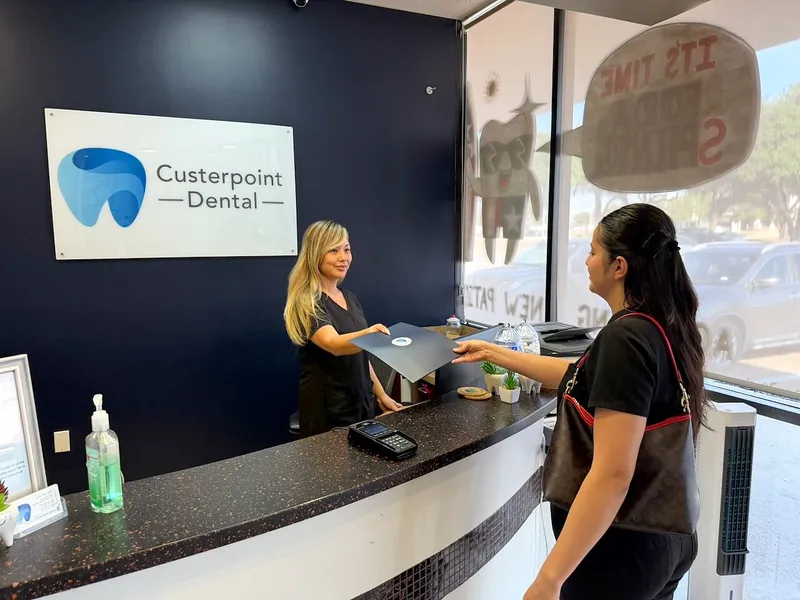
You sit across a desk from your dentist and say what worries you, in your own words. That conversation shapes how everything after it is paced.
- 02A digital scan and low-radiation images
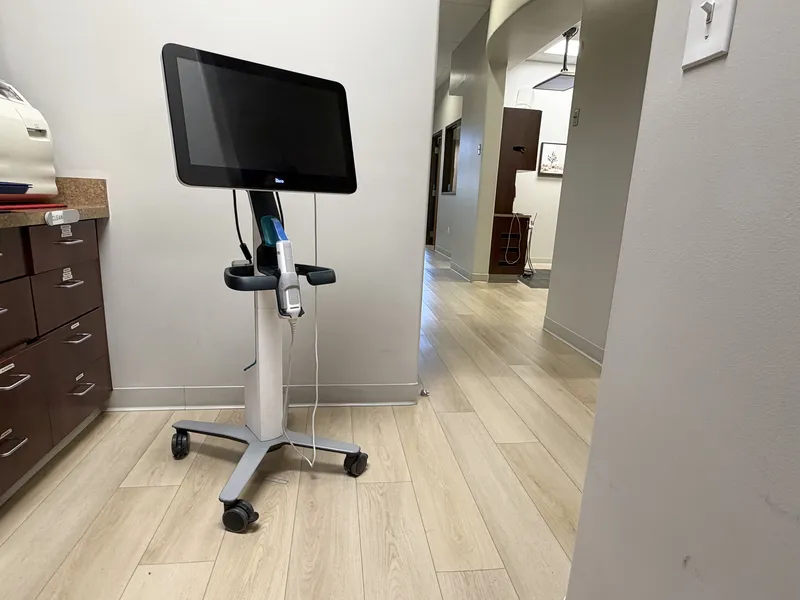
An iTero scanner records your teeth without putty, and low-radiation digital images show what is under the surface. Nothing sharp is involved.
- 03Your own mouth on the screen
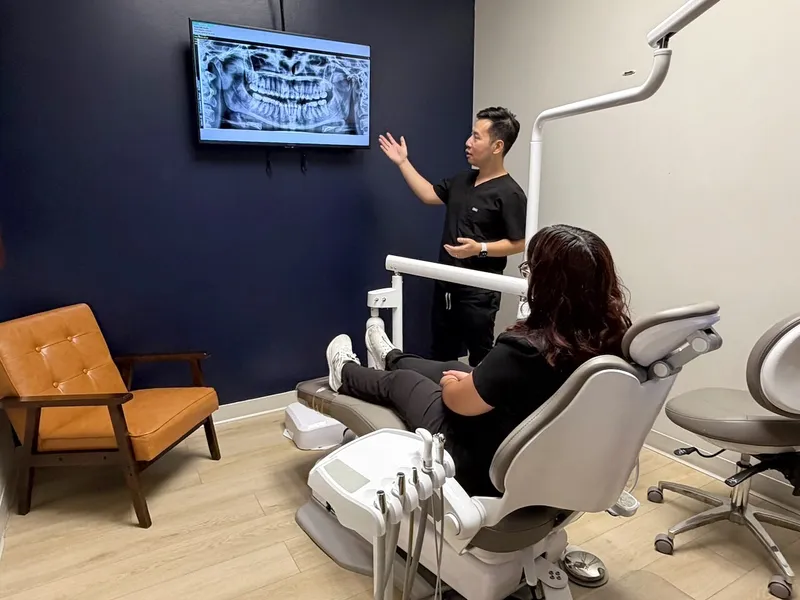
We show you what we see on the chairside screen and explain it plainly, so you are never guessing about what is going on.
- 04A written plan with priorities
You get a plan sorted by what matters now and what can wait. Nothing starts that day unless you want it to.
- 05A pace you choose
If one thing per visit feels right, that is how we schedule it. You can also take the plan home and decide later.
For many adults, the hardest part of the whole process is making the first phone call. Once you are in the room, the visit is mostly a conversation with pictures.
For more on what the exam itself covers, see our new patient exam page.
What makes a modern visit more comfortable than you remember?
Much of what people dread about the dentist comes from tools and habits that have changed a great deal in the last twenty years.
The visit you may remember, and the visit here
Here is how the usual sticking points compare at our office.
| Feature | What you may remember | What a visit here is like |
|---|---|---|
| Impressions | A tray of putty held in your mouth until it set | An iTero digital scan, with no putty and no tray |
| X‑rays | Film, chemicals and a long wait | Low-radiation digital images, and cone-beam CT when a 3D view is needed |
| Small cavities | The high-speed drill, almost every time | Drill-free options for small cavities where the tooth allows it |
| Seeing the problem | Being told something was wrong | Seeing it yourself on the chairside screen |
| The plan | A quick verbal summary | A written plan with priorities you can take home |
Drill-free methods suit small, early cavities. Deeper decay usually still needs a conventional filling, done with the same patience. | ||
The chairside screen matters more than it sounds. When you can see the spot on your own tooth, the conversation shifts from trusting a stranger to deciding together.
The drill-free options at our Plano office include air abrasion, a dental laser, silver diamine fluoride and resin infiltration. Your dentist chooses the one that fits the tooth.
Can you stop if it gets too much?
Yes, and you do not have to explain why. Before any treatment begins, we agree on a hand signal that means stop.
When you raise your hand, we pause as soon as the tooth is safe to leave, and wait until you are ready to go on or decide that is enough for the day.
It also helps to tell us which part bothers you most, whether that is a sound, a sensation, the feeling of lying back or simply not knowing what comes next. Each one has a different fix, and naming it lets us plan around it.
What if it has been years since your last visit?
Then you are exactly who this first visit is for, and our job is to show you where things stand today, not how you got here. Whether it has been three years or fifteen, catching up usually happens in a few steps, not one long appointment.
Catching up in stages
- Exam and scan: a full look at your teeth, gums and bite, with the images on the screen beside you.
- A cleaning sized to your gums: a regular cleaning if your gums are healthy, or a deep cleaning if they need it. Our guide to deep cleaning vs regular cleaning explains the difference.
- Fix what hurts first: anything causing pain or likely to get worse soon goes to the top of the plan.
- The rest in phases: everything else is scheduled at a pace that fits your comfort, your calendar and your budget.
You will not be pushed to finish everything at once. Some patients complete their plan in a few months, while others spread a larger plan, such as a full mouth restoration, across a year or more, and both are normal.
Whatever the exam shows, you see it on screen and hear every option. When something does need work, it is usually easier to handle now than later. Results vary.
What about the cost surprise?
You get a written, itemized quote before any treatment begins, so the number is never a surprise after the fact.
If you have PPO insurance, we file the claims for you and can request an estimate of what your plan will pay. For the share insurance does not cover, Cherry or CareCredit let you pay over time, subject to credit approval.
If the plan has several phases, the quote shows each one, so you can see what is urgent and what can wait for a later month or a new plan year.
Is there a dentist who speaks Cantonese?
Yes. Dr. Tam speaks Cantonese, and hearing your treatment explained in your own language often removes a whole layer of worry; see our Chinese-speaking dentist page.
What is the next step?
If you have been putting off the dentist because of nerves, the next step in Plano is a conversation, not a procedure.
You do not have to be ready for treatment to get in touch, and you do not need a plan in mind. Wanting to know where you stand is reason enough, and if you would like us to narrate each step as we go during any visit, just ask.
Call 972-265-9033 to just ask questions first, with no appointment and no commitment, or book a visit at our office on Custer Road in Plano when you are ready. Mention that you are nervous so we can pace the visit around you, and find directions on our Plano location page.